

The rhythmic gate
you write.
One line of notation. Drawn as the envelope it plays. Locked to your DAW.
Free 14-day trial, everything on. Version 1.0.3, signed. Also for .
VST3 · AU · macOS and Windows · one licence, 2 machines
Hear it
Real audio, through the real plugin.
One source, one pattern, rendered through Strand. Flip between dry and gated while it plays.
Synth pad
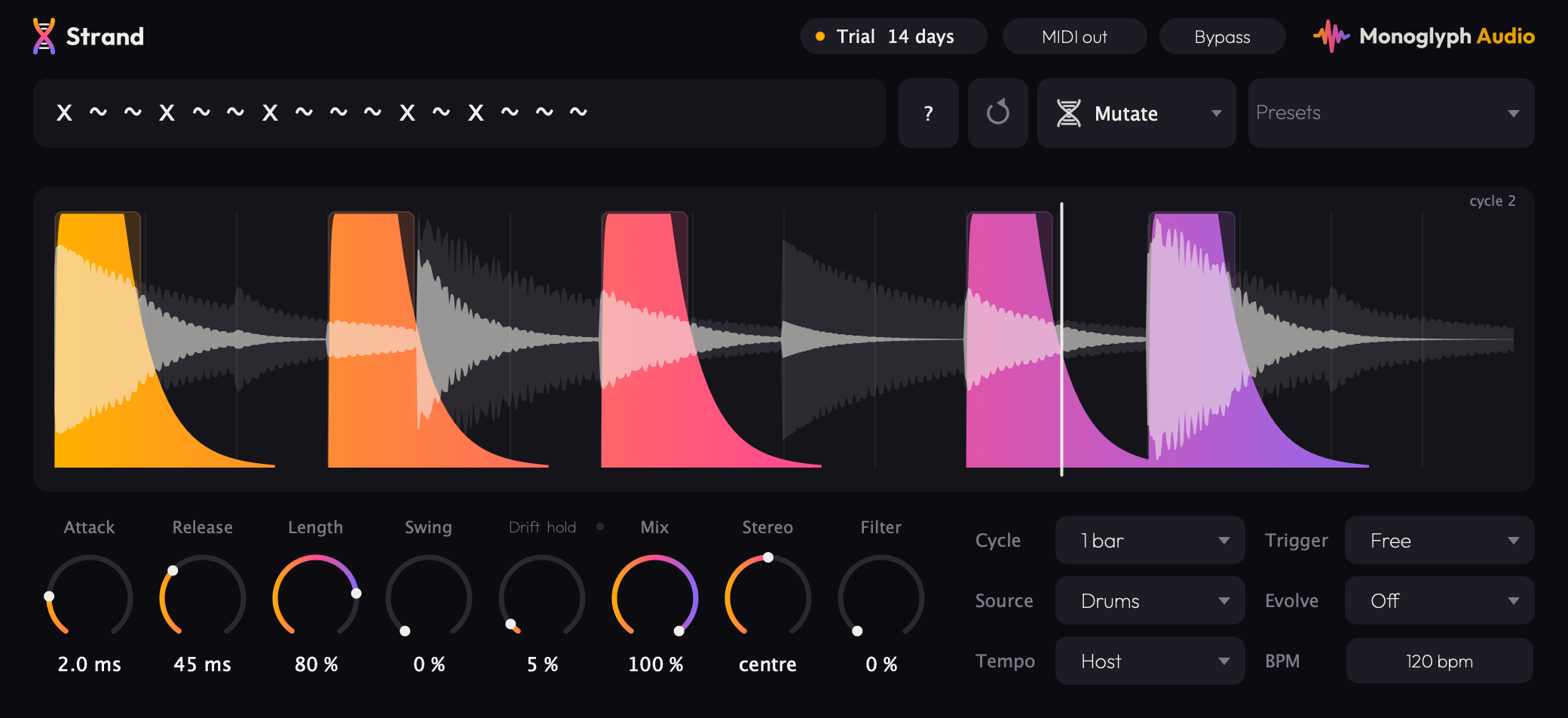
x ~ x ~ ~ x ~ ~ x ~ ~ x ~ x ~ ~The son clave. A held chord turns into a rhythm section without touching the notes.
Vocal
x(3,8)Three hits over eight. The long tail of the voice is what the gate is cutting.
Guitar chord
<x ~ x [x x]> x*2Alternation: the first half of the bar changes every cycle, the second half never does.
The language
Thirteen symbols.
The mini-notation from TidalCycles and Strudel, the live-coding languages. This is all of it, each symbol drawn as the gate it plays.
> x x x x
1 bar · 120 bpm
x · a hit (any word works)
TidalCycles and Strudel are open-source projects by Alex McLean, Felix Roos and contributors. Monoglyph Audio is not affiliated with or endorsed by them; Strand reads the same notation with a parser of its own.
Inside
The display
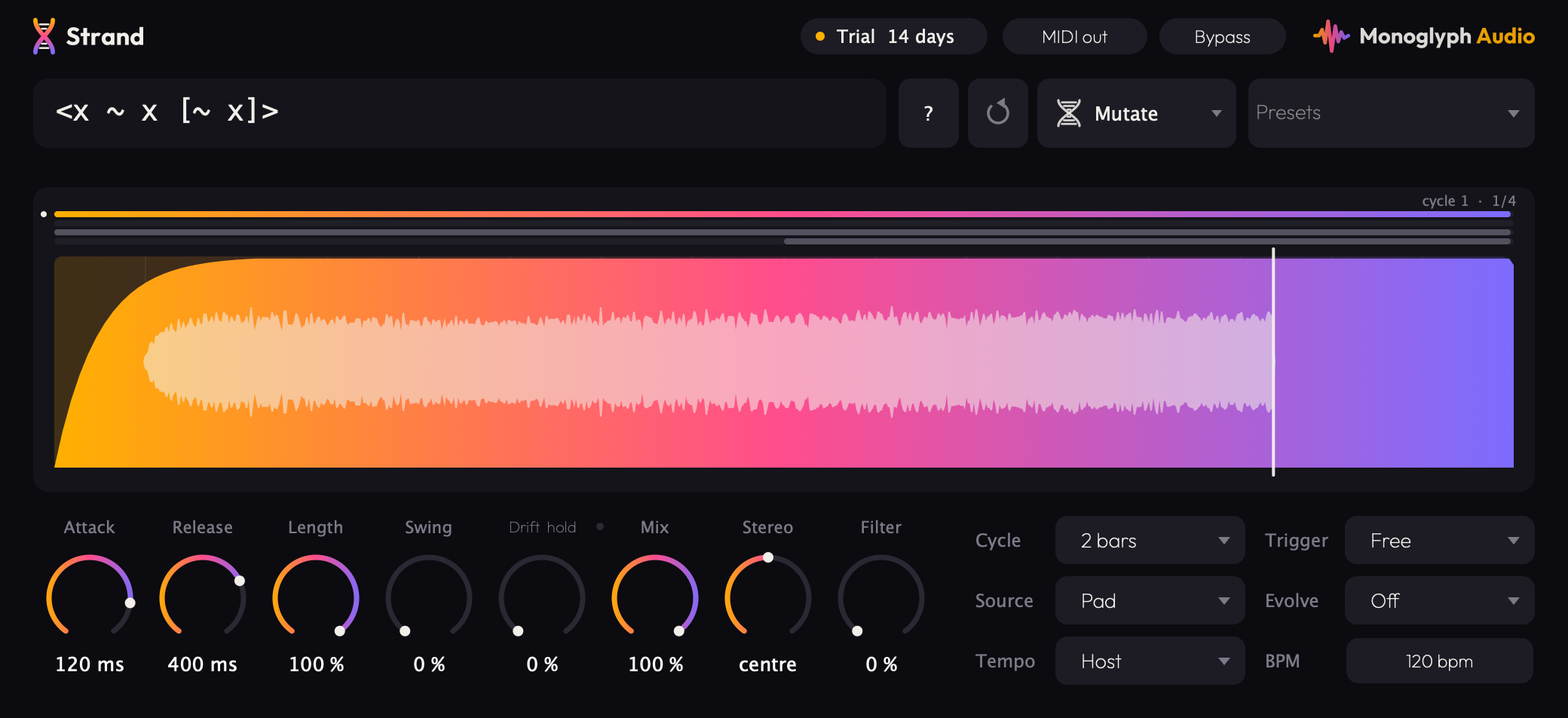
What you see is the gate.
Every bar is the real envelope: attack rises it, release trails it, Length closes it. Swing and Drift move bars and leave ghosts where they were. Your audio sits underneath, folded onto the cycle, bright where it survives.
Mutate and Evolve
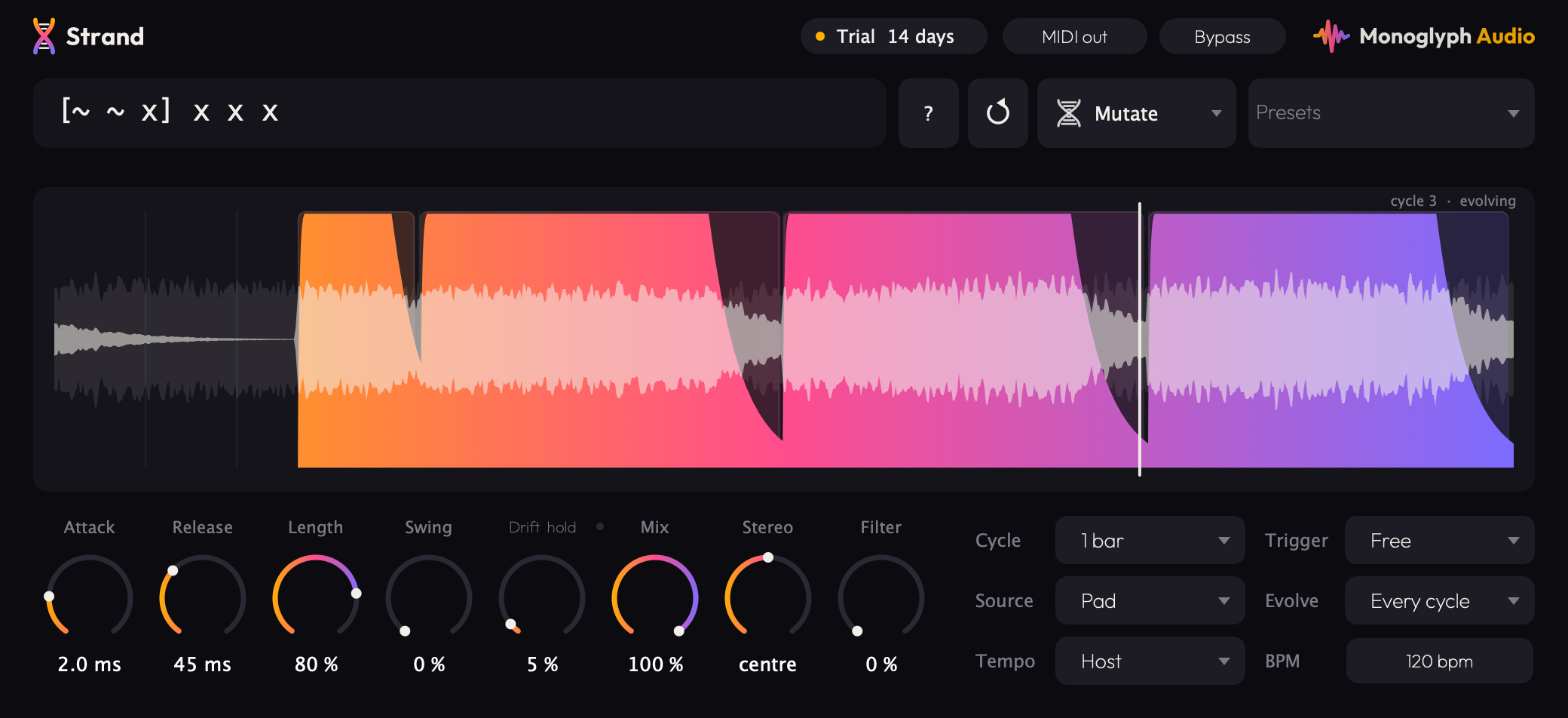
One musical change at a time.
Mutate makes a small edit that always parses and always sounds different; right-click to say what kind. Evolve does it every 1, 2, 4, 8 or 16 cycles, landing on the boundary. Bar 37 always plays the way it played last time.
Groove, MIDI, stereo
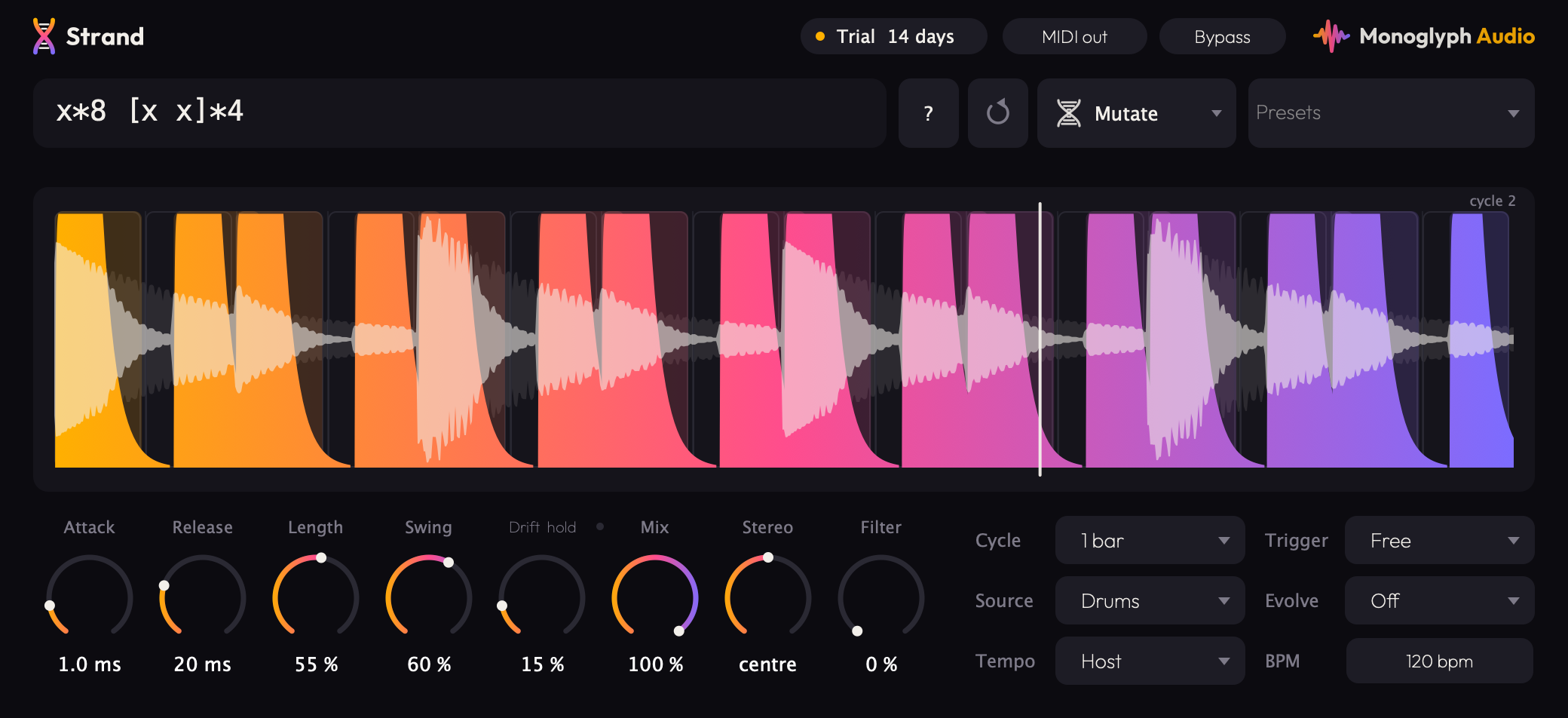
It sits in the track.
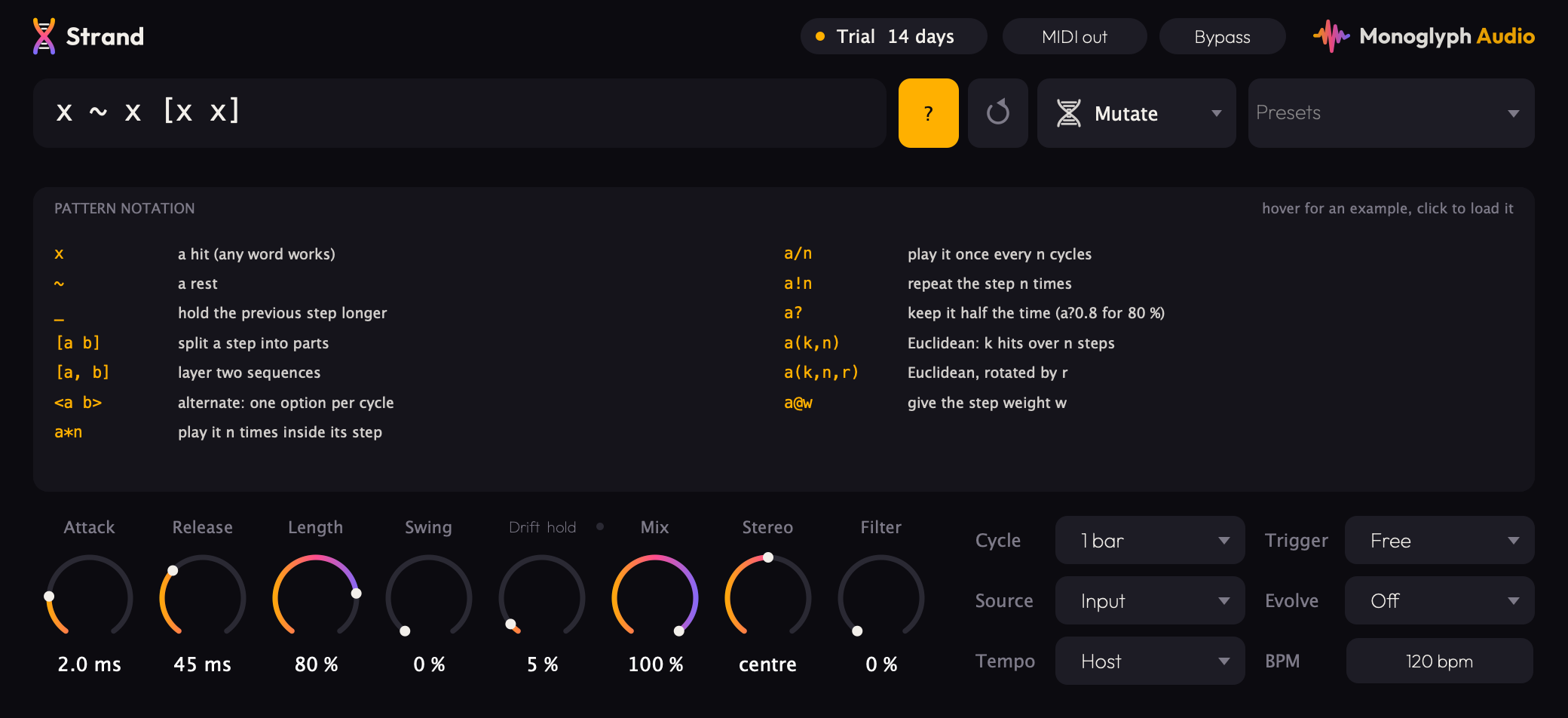
Swing follows the pattern’s finest subdivision. A note-on restarts the cycle and the gate goes out as notes. Offset the right channel a grid step for ping-pong chops, and close a low-pass with the gate for darker cuts.
Presets and the sheet
Fifty-five starting points.
Claves, breaks, grooves, evolving patterns and dynamics tools, by feel. Save your own as small files. The whole notation fits on one panel, one click away, and a built-in pad and noise source let you audition a pattern with nothing plugged in.
Pricing
$39.99
Once. Every update to Strand 1, no subscription. £34.99 in the UK and €39.99 in the eurozone, VAT included; $39.99 elsewhere, converted to your own currency at checkout, with sales tax added where it applies.
- VST3 and Audio Unit for macOS 10.13 and later, Universal.
- VST3 for Windows 10 and later, 64-bit.
- A standalone app on both, for patterns with nothing else open.
- One licence covers 2 machines. Move it by deactivating one, in the plugin or in your account.
- Sold through Paddle, our merchant of record, so invoices and refunds are handled by them. Refund policy.
Trial
Fourteen days, everything on.
One build covers the trial and the full version. Install it, use it in your sessions, and if it earns its place, a key by email turns it into yours. When the trial ends audio passes through untouched; your patterns and presets are kept.
- No account and no card to start. The trial begins the first time the plugin runs.
- Version 1.0.3. Universal .pkg for macOS, signed and notarised; a signed installer for Windows.
- One build for the trial and the full version. A key turns it into yours; nothing to reinstall.
Questions
Short answers.
Everything else is in the manual.

Something the manual doesn't cover?
Write to the people who wrote the code. Replies usually land within a working day.
hello@monoglyphaudio.comDo I need to know TidalCycles or Strudel?
No. The notation is thirteen symbols and the cheat sheet is one click away in the plugin. If you do know them, you already know Strand.
Which formats?
VST3 and Audio Unit on macOS 10.13 and later, Universal for Intel and Apple Silicon. VST3 on Windows 10 and later, 64-bit. No AAX yet.
Is there a trial?
Fourteen days, everything on, from first run. Afterwards audio passes through untouched until you enter a key. Your patterns and presets are kept.
How does licensing work?
You get a key by email. Activate it on the machines you use; move it by deactivating. No account required, no dongle, no phoning home beyond a daily check that a licensed machine is still licensed.
What does Mutate actually do?
It parses your pattern into a tree, picks one place in it, and makes one small move: nudge a number, split a step, flip a hit, wrap it in an alternation. It never deletes, never goes silent, and always changes what you hear. A complexity budget keeps it from ballooning.
Can I automate the pattern?
Every knob and selector is a host parameter. The pattern text is saved with your project but is not automatable; use Evolve, alternation and presets for changes over time.